
Acrylic & PerspexAcrylicSKU ACCLS03001
Clear Acrylic Sheet (PMMA) | 3–12mm | Cut to Size | UK Stock
Price shown updates with the option you pick.
Clear Acrylic Sheet (PMMA) | 3–12mm | Cut to Size | UK Stock
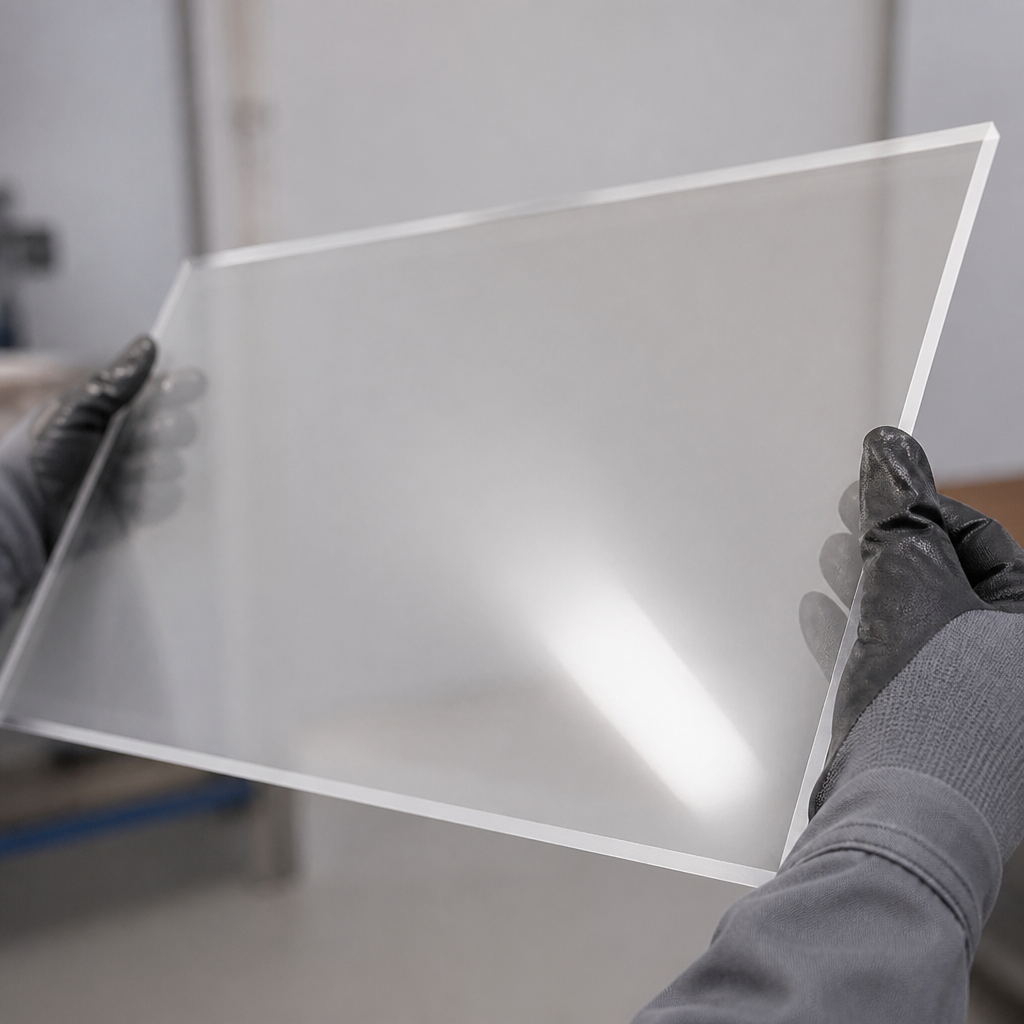
Optically clear acrylic sheet in seven thicknesses and six panel sizes, cut square and despatched from UK stock. Acrylic transmits 92% of visible light — more than window glass — at roughly half the weight and around ten times the impact resistance. Every thickness is available in every panel size, so there are no dead combinations to work around.
See the thickness guide and the acrylic / polycarbonate / glass comparison in the product images above.
Choosing your thickness
| Thickness | Typical use |
|---|---|
| 3mm | Picture frames, small panes, display backing |
| 4mm | Shed and greenhouse windows |
| 5mm | Secondary glazing, larger windows |
| 6mm | Machine guards, counter screens, shelving |
| 8mm | Structural panels, heavy shelving |
| 10mm | Free-standing screens, tank walls |
| 12mm | Load-bearing panels, machined parts, bases |
General guidance only — ask us before specifying acrylic for load-bearing or safety-critical glazing.
Panel sizes and weights
Acrylic weighs about 1.19kg per m² per mm of thickness — roughly half the weight of the same pane in glass. To estimate any piece: length (m) × width (m) × thickness (mm) × 1.19 = weight in kg.
| Panel size | Area | At 3mm | At 6mm | At 12mm |
|---|---|---|---|---|
| 250 × 250mm | 0.06m² | 0.22kg | 0.45kg | 0.89kg |
| 500 × 250mm | 0.13m² | 0.45kg | 0.89kg | 1.79kg |
| 500 × 500mm | 0.25m² | 0.89kg | 1.79kg | 3.57kg |
| 1000 × 500mm | 0.50m² | 1.79kg | 3.57kg | 7.14kg |
| 1000 × 1000mm | 1.00m² | 3.57kg | 7.14kg | 14.28kg |
| 2000 × 1000mm | 2.00m² | 7.14kg | 14.28kg | 28.56kg |
Material Specifications
| Property | Value |
|---|---|
| Material | Acrylic (PMMA, polymethyl methacrylate) |
| Colour | Clear, colourless |
| Light transmission | ~92% (float glass is ~88%) |
| Density | 1.19 g/cm³ |
| Refractive index | 1.49 |
| Continuous service temp | Up to 70°C |
| Thermal expansion | ~0.07mm per metre per °C |
| Thermoforming temp | 150–160°C |
| Cut tolerance | +2mm / -0mm |
| Protective film | Normally masked both faces — peel after fabrication |
Acrylic, polycarbonate or glass?
The three get confused constantly. This is the honest comparison:
| Acrylic | Polycarb | Glass | |
|---|---|---|---|
| Light transmission | 92% | 88% | 88% |
| Impact vs glass | ~10× | ~200× | 1× |
| Scratch resistance | Good | Poor | Best |
| Weight vs glass | ~half | ~half | — |
| Max temperature | 70°C | 115°C | High |
| Laser cuts cleanly | Yes | No | No |
If your panel is likely to be struck, or needs to survive a football, choose polycarbonate instead. If clarity and finish matter most, acrylic wins.
Fabrication guide
- Sawing: use a fine-tooth blade at high speed and low feed. Leave the protective film on while cutting.
- Drilling: use a bit ground for plastics, or back off a standard bit. Always drill clearance holes — at least 2mm larger than the fixing — and never tighten a bolt hard against acrylic.
- Allow for movement: acrylic expands about 0.07mm per metre per °C. A 1m panel through a 40°C swing moves nearly 3mm, so glazing rebates need clearance or the sheet will bow or crack.
- Laser cutting: acrylic lasers beautifully and leaves a flame-polished edge. Unlike PVC it releases no chlorine, so it is safe on any laser.
- Bonding: use an acrylic solvent cement (Tensol or similar), not superglue.
- Thermoforming: heats and bends cleanly at 150–160°C with a line bender or oven.
- Edge finishing: sawn edges can be scraped, sanded and flame or buff polished to optical clarity.
Looking after it
Never clean acrylic with glass cleaner. Ammonia-based products — Windolene, most blue sprays — attack the surface and cause fine cracks called crazing that cannot be polished out. Use warm water with a little washing-up liquid and a soft microfibre cloth, or a dedicated acrylic polish. Never dry-wipe a dusty sheet; grit will scratch it.
Frequently Asked Questions
Is this the same as Perspex?
Perspex is a brand name for acrylic, in the same way Hoover is a brand of vacuum cleaner. This is the same material — clear PMMA — supplied unbranded, which is why it costs less.
Is it cast or extruded acrylic?
Cast acrylic machines and laser cuts a little more cleanly and holds a polish better; extruded holds a tighter thickness tolerance and thermoforms more easily. For the great majority of glazing, display and panel work either performs identically. If your job specifically requires cast, contact us before ordering and we will confirm the grade on the batch.
Can I use it outdoors?
Yes. Acrylic is inherently UV stable and will not yellow or go brittle the way cheaper plastics do. It is the standard choice for shed, greenhouse and secondary glazing.
Will it shatter?
It is far tougher than glass and breaks into large blunt pieces rather than shards. For genuine impact protection, polycarbonate is around twenty times tougher again.
Does it arrive with a protective film?
Normally yes, masked on both faces. Leave it on while you cut and drill, then peel it off.
Can it be bent cold?
No. Cold bending stresses the sheet and causes crazing. Heat it to 150–160°C and form it warm.
Do you cut sizes not listed?
Yes. Send us your dimensions and thickness and we will quote a custom cut, usually from a full sheet.
Why buy from us
- UK stock — same-day despatch on orders placed before the cut-off
- Every thickness available in every panel size — no dead combinations
- Cut square to +2 / -0mm, normally masked both faces
- Published weights and specifications so you can plan the job before it arrives
- Real UK specialists on the phone, Mon–Fri 8:30–17:00
Product details
| SKU | ACCLS03001 |
|---|---|
| Material | Acrylic |
| Form | Sheet |
Same material, other forms
Need a different shape, size or grade? Explore the full range:
Request a quote
Fast, no-obligation price from our UK team for:Clear Acrylic Sheet (PMMA) | 3–12mm | Cut to Size | UK Stock