
Engineering PlasticsPolycarbonateSKU PLC_IPL0009
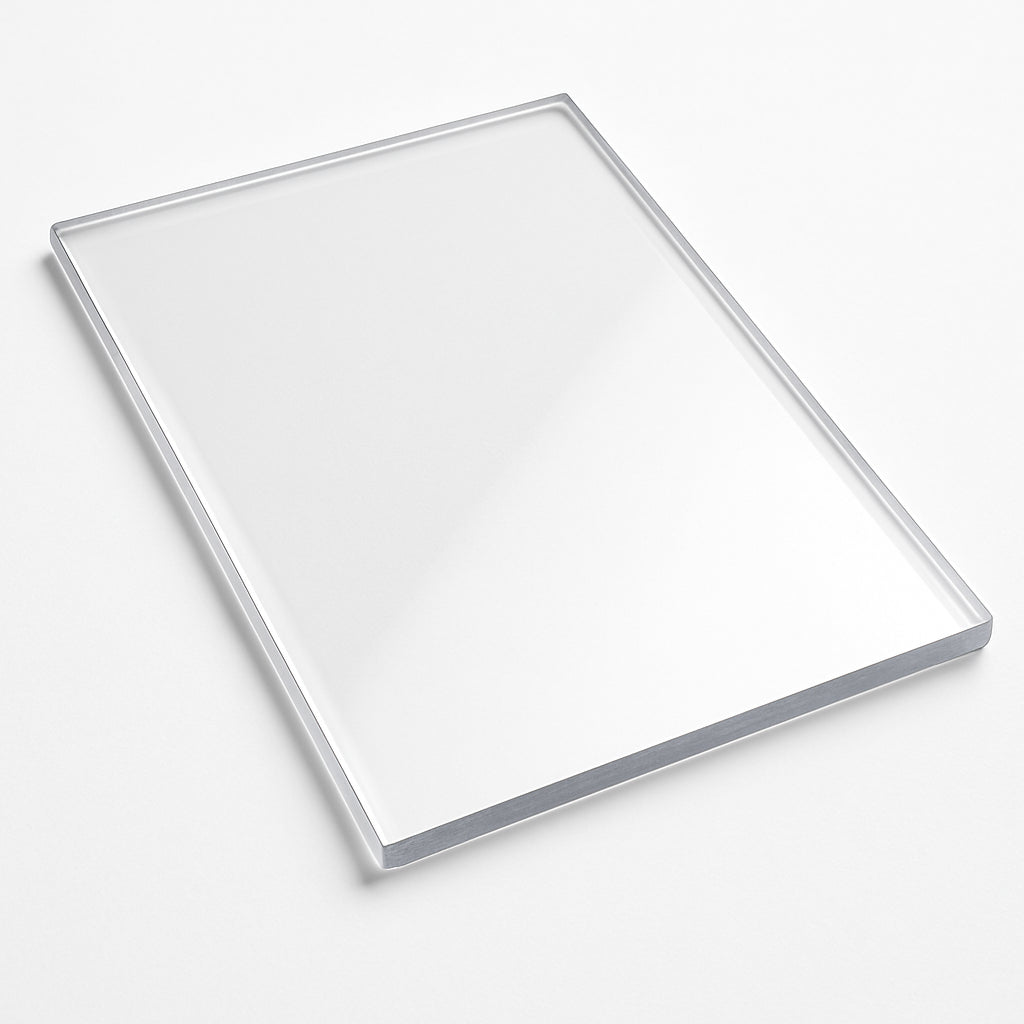
Clear Polycarbonate Sheet Cut to Size 2mm to 12mm Impact Resistant
Price shown updates with the option you pick.
Clear Polycarbonate Sheet – Impact Resistant Glazing | Cut to Size | UK Stock
Our clear polycarbonate sheet is one of the toughest transparent materials available — approximately 250 times stronger than glass at equivalent thickness, yet half the weight. UV-stabilised as standard for outdoor and indoor use. Available cut to your exact size in 8 thicknesses from 2mm to 12mm, or in popular pre-cut formats for fast dispatch.
Custom Size? Instant Price & Order Online
Any size from 100 × 100mm up to 3050 × 2050mm (12mm up to 2440 × 1220mm), cut to ±1mm. Enter your dimensions:
Your exact cut dimensions are attached to the order line. Price includes VAT and precision cutting. Prefer to talk it through? Call +44 1282 277786 or request a quote.
Price Guide (full 2440 × 1220mm sheets, inc VAT & delivery)
| Thickness | 2mm | 3mm | 4mm | 5mm | 6mm | 8mm | 10mm | 12mm |
|---|---|---|---|---|---|---|---|---|
| From £/m² | £61 | £86 | £115 | £143 | £172 | £229 | £286 | £344 |
Rates shown are for full sheets — smaller cut panels cost more per square metre. Use the calculator above for an exact price on your size.
Technical Specifications
| Material | Clear Polycarbonate (PC) — Makrolon / Lexan equivalent grade |
| Colour | Clear / Optically Transparent |
| Available Thicknesses | 2mm, 3mm, 4mm, 5mm, 6mm, 8mm, 10mm, 12mm |
| Available Sizes | 100×100mm to 3050×2050mm (cut to size), plus standard pre-cut formats |
| Impact Strength | ~250× stronger than glass | ~30× stronger than acrylic |
| Light Transmission | Up to 90% (optically clear) |
| Operating Temperature | -40°C to +120°C continuous |
| UV Resistance | UV-stabilised both sides — suitable for external use |
| Flammability | Self-extinguishing — Class 1 fire rating (better than acrylic) |
| Density | 1.2 g/cm³ |
| Thermal Expansion | 0.07mm per °C per 100mm length |
| Supply | Supplied with protective film both sides |
| Food Safety | Food-contact safe grade available — suitable for food processing environments |
Thickness Selection Guide
| Thickness | Best Applications | Approx. Weight |
|---|---|---|
| 2mm | Light-duty glazing, display cases, signage, small picture frames | 2.4 kg/m² |
| 3mm | Greenhouse panels, shed windows, light machine guards | 3.6 kg/m² |
| 4mm | General purpose glazing, anti-vandal panels, medium machine guards — most popular | 4.8 kg/m² |
| 5mm | Structural glazing, high-traffic areas, secondary glazing panels | 6.0 kg/m² |
| 6mm | Heavy machine guards, security screens | 7.2 kg/m² |
| 8mm | High-security applications, rooflights in exposed locations | 9.6 kg/m² |
| 10mm | Very high impact resistance, security enclosures, industrial safety barriers | 12.0 kg/m² |
| 12mm | Maximum impact resistance, heavy industrial barriers and enclosures | 14.4 kg/m² |
Key Features & Benefits
- 250× stronger than glass — virtually unbreakable; ideal where safety and security are critical
- Half the weight of glass — easier and faster to install, reduced structural loading
- Up to 90% light transmission — as optically clear as glass, ideal for glazing and display
- UV-stabilised both sides — won't yellow or degrade outdoors; suitable for years of external use
- Class 1 fire rating — self-extinguishing, safer than acrylic in public buildings, schools, airports
- Cold-bendable — can be curved without heating (minimum bend radius: 150× thickness)
- Thermally formable — can be oven-formed for complex curved shapes
- Easy to machine — cuts, drills and routes with standard woodworking or metalworking tools
- Chemical resistant — resistant to dilute acids, aliphatic hydrocarbons and alcohols
Common Applications
- Machine guards & safety screens — the industry standard for rotating machinery protection
- Anti-vandal glazing — bus shelters, phone boxes, transport hubs, public buildings
- Greenhouse & shed windows — lightweight, shatterproof alternative to glass
- Rooflights & skylights — excellent light transmission with superior strength vs glass
- Security screens — banks, post offices, retail counters and kiosks
- Display cases & retail fixtures — clear, professional appearance for product display
- Racing car & motorsport windows — lightweight, impact resistant glazing
- Agricultural panels — UV stabilised for outdoor longevity in polytunnels and greenhouses
- Noise barriers — secondary glazing for acoustic attenuation
Installation & Working Guide
- Cutting: Use a circular saw or jigsaw with a fine-tooth blade. Score-and-snap works for 2mm–3mm. Leave protective film on during all cutting operations.
- Drilling: Standard HSS or wood drill bits. Use moderate speed, light pressure, and a scrap board underneath. Drill oversize holes to allow for thermal expansion.
- Fixing: Do not over-tighten screws — always drill clearance holes larger than the fixing diameter. Allow 2mm per metre of thermal expansion gap.
- Bending: Cold-bend along the long axis only. For tight bends, heat to 150°C–160°C in an oven (sheet must be pre-dried at 120°C for 2–4 hours to prevent bubbling).
- Cleaning: Mild soap solution and soft cloth only. Never use dry cloths, abrasive cleaners or solvents — these cause surface crazing.
- Adhesives: Bond with suitable polyurethane or silicone sealant. Avoid solvent-based adhesives which attack polycarbonate.
Polycarbonate vs Acrylic — Which Should You Choose?
| Property | Polycarbonate | Acrylic (Perspex) |
|---|---|---|
| Impact resistance | ✓ Virtually unbreakable | ⚠ Can crack and shatter |
| Optical clarity | ✓ Up to 90% transmission | ✓ Up to 92% transmission |
| Scratch resistance | ⚠ Moderate | ✓ Better than PC |
| Fire rating | ✓ Class 1 — self extinguishing | ⚠ Class 3 — burns |
| Weight | 1.2 g/cm³ | 1.19 g/cm³ (similar) |
| Cold bending | ✓ Yes | ✗ Cracks if cold bent |
| UV resistance | ✓ Good (UV stabilised) | ✓ Excellent |
| Best for | Safety, security, impact protection | Optical clarity, displays, signs |
Why Choose Industrial Polymers?
- ✓ UK stock for fast dispatch — order before 2pm Mon–Fri for same-day dispatch
- ✓ Precision cut to size — any dimensions from 100mm × 100mm to 3050mm × 2050mm
- ✓ Expert technical support — call +44 1282 277786 for material selection advice
- ✓ Trade pricing available — volume discounts for regular orders over £500
- ✓ 3,000+ plastic products in stock across 30+ materials
Product details
| SKU | PLC_IPL0009 |
|---|---|
| Material | Polycarbonate |
| Form | Sheet |
Same material, other forms
Need a different shape, size or grade? Explore the full range:
Request a quote
Fast, no-obligation price from our UK team for:Clear Polycarbonate Sheet Cut to Size 2mm to 12mm Impact Resistant