
Rubber & FoamSKU IP-EPDMS-22.5X18-14M
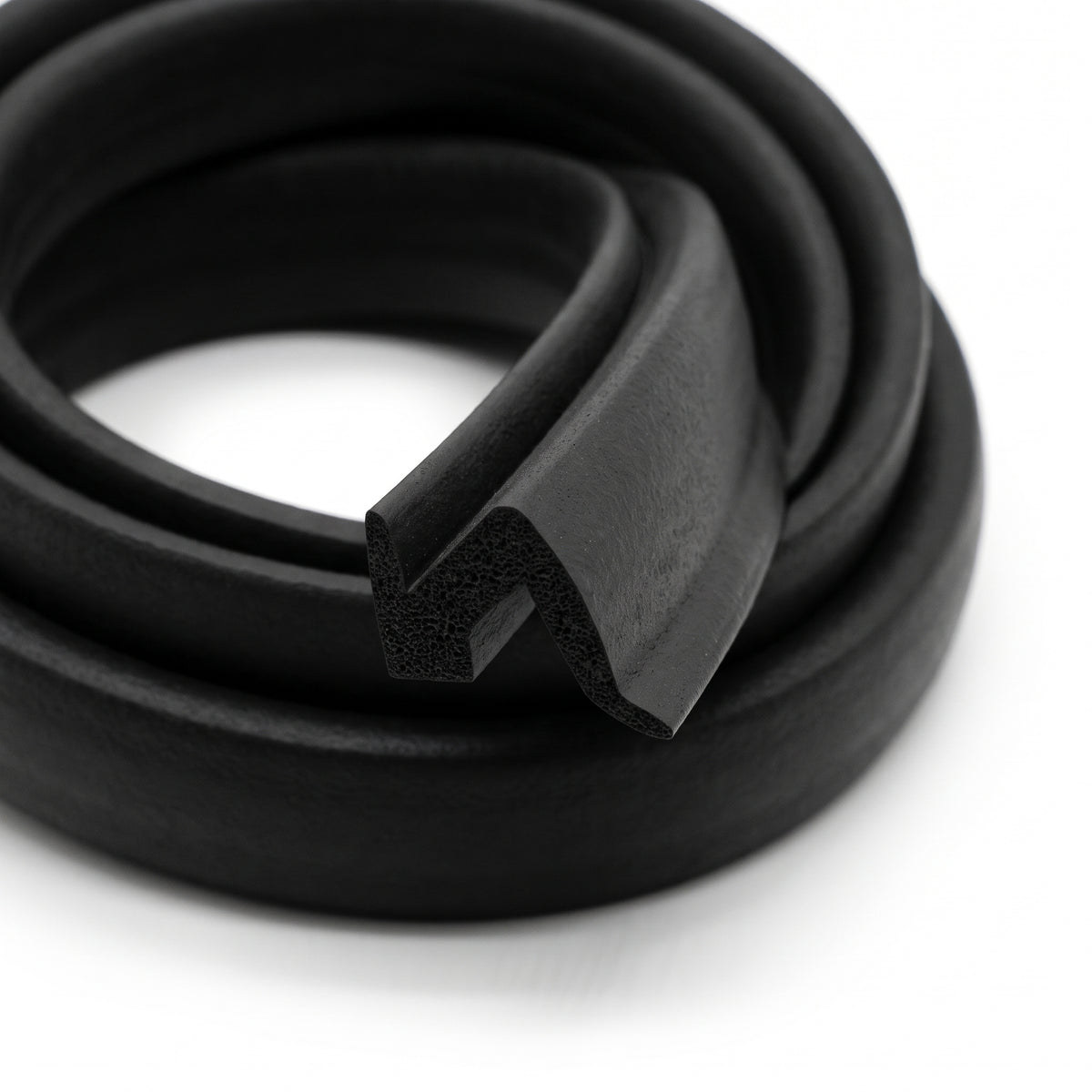
EPDM Sponge Lip Seal – 22.5mm x 18mm, Solid Closed-Cell, Black – 14m to 50m Coil
Price shown updates with the option you pick.
A soft, solid EPDM sponge lip seal, 22.5 mm wide and 18 mm high, for doors, hatches, lids, enclosures and window frames where the gap is uneven. It has a flat 6 mm foot that you bond to the frame, a 13 mm front lip and a taller angled blade that folds over as the door closes. Because the sponge is soft (40 Shore OO), it closes gaps of different widths along one run and still gives an air- and water-resistant seal. Cut it to length with a knife. It is supplied as one continuous piece from 14 m up to a full 50 m coil.
At a glance
- Section: 22.5 mm wide × 18 mm high, with a 13 mm front lip and a 6 mm flat foot
- Material: black closed-cell EPDM sponge with a smooth skin, 40 Shore OO
- Weather: excellent ozone, UV and weather resistance; passes a flexibility test at −40 °C
- Light: 0.08 kg per metre (0.5–0.9 g/cm³ density)
- Lengths: 14 m to 49 m cut lengths, or a full 50 m coil at a lower price per metre
- In stock for same-day dispatch
Technical drawing

The section is drawn to scale from the sizes stated by the manufacturer. Intermediate contours are nominal. Sponge sizes are quoted to the nearest 0.5 mm.
How it seals
Bond the flat foot to the frame, with the angled blade facing the closing door or lid. When the door closes, the blade folds down towards the tail and the front lip presses against the door face, so the seal makes contact along two lines. The closed-cell sponge recovers when the door opens, and the skinned surface keeps out water and dirt. It works best where the closed gap is clearly less than 18 mm, so the blade is always under some compression.

Specifications
| Property | Value | Test method / basis |
|---|---|---|
| Overall width | 22.5 mm | Manufacturer's drawing, nominal (nearest 0.5 mm) |
| Overall height | 18 mm | Manufacturer's drawing, foot face to top of blade |
| Front lip height | 13 mm | Manufacturer's drawing, from foot face |
| Base foot width (bonding face) | 6 mm | Manufacturer's drawing |
| Section type | Solid sponge, no hollow core | Manufacturer's drawing |
| Dimensional tolerance | BS 3734 Class E3 | BS 3734-1 (extruded sections) |
| Material | Expanded (closed-cell) EPDM sponge, skinned | Manufacturer's data |
| Colour | Black | - |
| Hardness | 40° Shore OO | Shore OO durometer |
| Density | 0.5–0.9 g/cm³ | Manufacturer's data sheet |
| Weight | 0.08 kg per metre (4.0 kg per 50 m coil) | Manufacturer's data sheet |
| Water absorption | 5% maximum | Manufacturer's data sheet |
| Compression set | 25% maximum (data sheet, 24 h recovery); 50% (product page, 22 h) | Manufacturer's data. The two published figures differ, so plan for the higher one. |
| Oven ageing | ±30% change | 7 days at 70 °C |
| Low-temperature flexibility | Pass at −40 °C | Manufacturer's data sheet |
| Ozone resistance | Excellent | Manufacturer's data sheet |
| Weather resistance | Excellent | Manufacturer's data sheet |
| UV light resistance | Excellent | Manufacturer's data sheet |
| Mould growth resistance | Very good | Manufacturer's data sheet |
| Upper service temperature | Up to about +100 °C | Typical for EPDM sponge, not tested on this profile |
| Tensile strength, elongation, tear strength | Not published for this profile | - |
| Supplied length | 14 m – 49 m cut lengths, or 50 m full coil | One continuous piece per order line |
Materials and compliance
The seal is made from black EPDM (ethylene propylene diene monomer) sponge. EPDM is chosen for outdoor seals because it resists ozone, UV and weathering much better than natural rubber or neoprene. It also handles water, steam, dilute acids, alkalis and ketones. It is not suitable for petrol, diesel, mineral oils or greases. The manufacturer's published data for this profile claims no food-contact, fire-rating, WRAS or other approvals, so we do not claim any. If you need a certified seal, please ask us.
Typical uses
- Enclosure, cabinet and kiosk doors with an uneven or variable gap
- Hatches, lids and access panels on vehicles, trailers and boats
- Shed, workshop and outbuilding doors and windows
- Draught and dust sealing on timber or metal frames
- Machine guards and covers that need a soft, low-closing-force seal
How much do I need?
Measure around the whole frame where the seal will run and add about 5% for corners and trimming. Then choose the next length up. For example, a 2 m × 1 m door seals on three sides with about 5 m, so a 14 m length does two doors with spare. For 50 m, the full coil costs less than a 41 m cut length.
Fitting
- Clean the frame with isopropyl alcohol and let it dry. The surface must be free of dust, oil and old adhesive.
- Dry-fit the seal with the blade leaning away from the hinge side, so the closing door folds it over.
- Bond the 6 mm foot with a rubber-compatible contact adhesive or a cyanoacrylate for EPDM. On porous surfaces, use a primer.
- At corners, either bend the seal round (radius about 25 mm or more) or mitre it at 45° and glue the faces.
- Let the adhesive cure fully before you shut the door hard on the seal.
Frequently asked questions
What size gap does it seal?
The free height is 18 mm. It seals best where the closed gap is about 6–15 mm, so the blade is always compressed. For gaps under about 5 mm, choose a smaller profile so the door still closes easily.
Which way round does it fit?
The flat 6 mm foot goes on the frame. The tall blade should lean away from the direction the door closes from, so the door folds it over rather than pushing it back on itself. The 13 mm lip then makes a second contact line.
Is it self-adhesive?
No. It has no adhesive backing. Bond it with a contact adhesive or a cyanoacrylate suitable for EPDM rubber. This gives a stronger, more heat-resistant bond than most tapes.
Can it be used outdoors?
Yes. The data sheet rates its ozone, UV and weather resistance as excellent, and it passes a flexibility test at −40 °C. It will not crack or harden in sunlight the way PVC or natural rubber can.
What temperatures can it take?
The manufacturer confirms flexibility at −40 °C. No upper limit is published for this profile. EPDM sponge typically handles continuous service up to about +100 °C, but this has not been tested on this profile.
How do I cut and join it?
Use a sharp craft knife or a fresh blade against a straight edge, in one clean stroke. To join ends, cut both square or at 45° and bond them with a cyanoacrylate for EPDM. Push the faces together for a few seconds.
Will it stand up to oil or fuel?
No. EPDM swells in petrol, diesel and mineral oils. For oily environments, ask us about nitrile or neoprene profiles.
Will a long length arrive in one piece?
Yes. Every length from 14 m to 50 m is supplied as one continuous piece, loosely coiled.
Need help?
Call +44 1282 277786 or email sales@industrial-polymers.co.uk with your gap size and application. We will confirm the right profile before you order.
Product details
| SKU | IP-EPDMS-22.5X18-14M |
|---|---|
| Weight | 2.69 lb |
More from this range
Request a quote
Fast, no-obligation price from our UK team for:EPDM Sponge Lip Seal – 22.5mm x 18mm, Solid Closed-Cell, Black – 14m to 50m Coil