
Rubber & FoamPolyethyleneSKU Bluefoam-A4
Expanded Polyethylene Foam Sheets 10mm | Self-Adhesive Closed-Cell XLPE
Price shown updates with the option you pick.
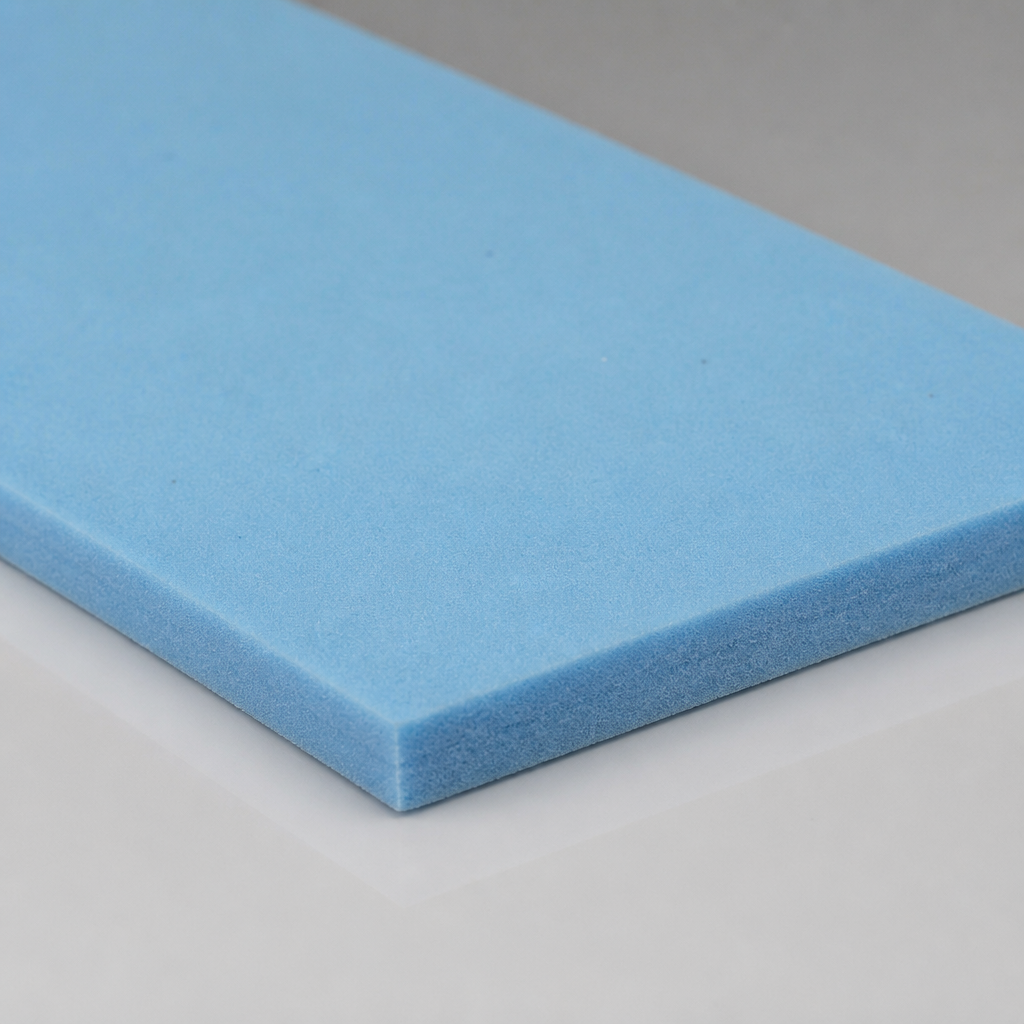
Self-adhesive closed-cell XLPE foam, cut to A4 and A3 sheets at a true 10mm thickness. This is cross-linked polyethylene foam — a firmer, finer-celled material than the soft packing foam sold in most craft shops. The closed-cell structure means it will not soak up water, will not rot or harbour mould, and springs back after being compressed, so it keeps working long after ordinary foam has flattened. One face carries a peel-off self-adhesive backing, so most jobs need nothing more than scissors and clean hands.
Which size do you need? Both sheets are the same 10mm foam — the only difference is how much of it you get.
| Sheet | Dimensions | Coverage | Weight | Typically bought for |
|---|---|---|---|---|
| A4 | 297 × 210 × 10mm | 0.062 m² | approx. 28g | Small pads and spacers, case inserts, anti-rattle strips, single repairs, sampling the material before committing |
| A3 | 420 × 297 × 10mm | 0.125 m² | approx. 56g | Twice the coverage of A4 — larger packaging inserts, panel lining, kneeling pads, multiple parts cut from one sheet |
Tip: cutting several small pads from one A3 sheet almost always works out cheaper than buying multiple A4s. Need a size we don't list? See Delivery, Dispatch & Custom Sizes below.
Technical Specification
| Material | Cross-linked closed-cell polyethylene foam (XLPE / EPE) |
| Colour | Blue, with removable white or yellow adhesive liner |
| Thickness | 10mm |
| Density | 45 kg/m³ |
| Cell structure | Closed cell — individual sealed cells, no interconnected voids |
| Adhesive | Pressure-sensitive self-adhesive on one face, protective peel-off liner |
| Operating temperature | −60°C to +90°C |
| Water absorption | Very low — typically under 1% by volume |
| Thermal conductivity | Typically around 0.038 W/m·K |
| Chemical resistance | Resistant to most greases, oils, dilute acids and alkalis |
| Biological resistance | Will not rot; does not support mould, mildew or bacterial growth |
| Workability | Cuts, carves and sands cleanly; no fibres, dust or crumbling |
| Supplied as | Single flat sheet per unit, protective liner in place |
Density, thickness, colour and temperature range are confirmed product data. Thermal conductivity and water absorption are typical published values for 45 kg/m³ closed-cell XLPE and are given as guidance rather than a guaranteed specification — if your application is safety-critical, contact us before ordering.
Key Properties
- Absorbs shock without bottoming out — the cross-linked cell walls dissipate impact energy and then recover, so one pad survives repeated knocks rather than crushing flat on the first.
- Genuinely waterproof — sealed cells mean water cannot travel through the foam. It stays light and dry in wet environments where open-cell foam turns into a sponge.
- Naturally buoyant — at 45 kg/m³ it floats readily and keeps floating, because it cannot waterlog.
- Thermally insulating — trapped air in closed cells slows heat transfer, useful for cold-chain packing, pipe wraps and panel lining.
- Damps vibration and impact noise — excellent under rattling panels, machine feet and hard-mounted fittings.
- Clean to work with — no loose fibres, no crumbling beads, no dust. It will not shed into equipment.
- Chemically stable — shrugs off grease, oil and most workshop chemicals.
- Dimensionally stable — holds its thickness and shape over time instead of sagging or hardening.
What It's Used For
- Protective packaging — cushioning instruments, electronics, glass and machined parts in transit; lining flight cases and tool boxes.
- Case and drawer inserts — cut pockets so tools and equipment sit still and protected.
- Anti-rattle and anti-squeak pads — behind trim panels, inside enclosures, under vehicle and machinery fittings.
- Buoyancy and marine — flotation inserts, boat and watersports equipment, anywhere waterlogging would be a problem.
- Thermal insulation — cold-chain packing, pipe lagging, panel and void insulation.
- Vibration isolation — under small machines, compressors, speaker cabinets and appliance feet.
- Light-duty gaskets and seals — dust and draught sealing on enclosures, hatches and covers.
- Construction — expansion joint filler, perimeter strips and void filling.
- Kneeling and comfort pads — for trades, gardening and workshop use; it will not absorb water from a wet floor.
- Craft, models and prototyping — carves and sands to shape cleanly for bespoke forms.
Fitting, Cutting & Working Guide
Applying the self-adhesive backing
- 1. Clean the surface. Wipe with isopropyl alcohol or a degreaser and let it dry fully. The adhesive bonds to the surface, not to grease or dust — this single step decides whether it stays put.
- 2. Dry fit first. Position the sheet with the liner still on and check the fit. Once the adhesive touches down it does not reposition well.
- 3. Peel and place progressively. Peel back a few centimetres of liner, set that edge down accurately, then pull the liner away underneath as you smooth the foam down. This avoids trapped air and creases.
- 4. Apply firm pressure. Press along the whole surface — pressure-sensitive adhesive needs it to key properly.
- 5. Mind the temperature. Apply at normal room temperature. Cold surfaces below about 10°C significantly weaken the initial grab; warm the parts first if you're working in an unheated space.
- 6. Let it cure. The bond keeps strengthening for around 24 hours — avoid loading or peeling it during that time.
Cutting and shaping
- Straight cuts: a sharp craft knife against a steel rule. Score once firmly rather than sawing repeatedly — one confident pass gives the cleanest edge.
- Curves and small parts: sharp scissors handle 10mm foam easily.
- Keep the blade sharp: a dull blade tears and drags the cells instead of slicing them.
- Cut with the liner on — it stiffens the sheet, protects the adhesive and gives you a surface to mark up.
- Shaping: carve with a knife and refine with medium-grit abrasive paper for chamfers and contours.
- Cut oversize by 1–2mm for a compression fit in pockets and recesses — the foam's recovery holds parts snugly.
XLPE vs Other Foams — Which Should You Choose?
Foam is not one material, and the wrong type fails quickly. Here is how this sheet compares to the alternatives you'll find elsewhere:
| Material | Cell structure | Water resistance | Feel | Best suited to |
|---|---|---|---|---|
| XLPE — this product | Closed cell, cross-linked | Excellent — will not waterlog | Firm with strong recovery | Packaging, buoyancy, insulation, vibration pads, light gaskets |
| EVA foam | Closed cell | Excellent | Softer and more flexible | Padding, mats, sports and footwear applications |
| Neoprene sponge | Closed cell rubber | Very good | Very soft, compresses far | Weather seals needing high compression on uneven gaps |
| Open-cell PU foam | Open cell | Poor — soaks up water | Very soft, low recovery | Upholstery and dry-area sound absorption |
| Expanded polystyrene | Rigid fused beads | Good, but fragile | Rigid, crumbles and sheds | One-trip void fill in disposable packaging |
In short: choose XLPE when the pad has to survive water, repeated compression, or both. Choose a softer sponge when you need to seal a wide, uneven gap under light pressure.
Frequently Asked Questions
What sizes and thicknesses are available?
A4 (297 × 210mm) and A3 (420 × 297mm), both 10mm thick. Custom sizes can be quoted — see the section below.
How strong is the self-adhesive backing, and what will it stick to?
It is a pressure-sensitive adhesive that bonds well to clean, dry, smooth surfaces — metal, glass, rigid plastics, sealed timber and painted panels. It performs poorly on dusty, oily, textured or porous surfaces such as bare masonry, and on flexible PP and PE plastics, which resist most adhesives. For those, cut the foam and bond it with a suitable contact adhesive instead.
Can I cut it myself?
Yes — scissors or a sharp craft knife are all you need. See the cutting guide above for clean edges.
Is it waterproof?
Effectively, yes. The closed-cell structure gives very low water absorption, so the foam does not soak through, waterlog or lose buoyancy. Water can still sit on the surface or track along a cut edge, but it does not travel through the material.
What temperature can it handle?
−60°C to +90°C, which covers freezer and cold-chain use at one end and hot workshop or engine-bay conditions at the other.
Can I use it outdoors?
Yes for general outdoor use — it resists moisture, rot and most chemicals. For permanent, fully exposed installations, bear in mind that unpigmented polyethylene foam gradually degrades under sustained direct UV; shielding it from constant sunlight extends its life considerably.
Is it good for soundproofing?
It depends what you're trying to stop, and this is where a lot of foam gets mis-sold. Closed-cell XLPE is very effective at damping vibration and impact noise — rattling panels, machine feet, footfall through a floor build-up. It is not an acoustic absorber for airborne sound such as voices or music; that job needs open-cell acoustic foam or dense mass. Many installations use both.
Will it fit through a letterbox?
An A4 or A3 sheet at 10mm thick and only 28–56g posts flat and light, so small orders travel as an ordinary packet rather than a bulky parcel.
Can I paint or glue it?
Polyethylene is a low-surface-energy plastic, so ordinary paints and adhesives struggle to key to it. Use adhesives formulated for PE foam (contact adhesive or hot-melt) and, if you must colour it, a flexible paint intended for plastics — test on an offcut first.
Is the foam food safe?
Treat this as a general-purpose industrial and packaging grade rather than a certified food-contact material. If you need documented food-contact compliance, contact us before ordering.
Is it recyclable?
The polyethylene itself is recyclable in principle, but cross-linked foam is not accepted in most household kerbside collections. Check with your local authority or a commercial waste stream.
Why does the 45 kg/m³ density matter?
Density is the best single indicator of how a foam will behave. At 45 kg/m³ this sits in the firm, protective range — supportive enough to hold parts securely and resist crushing, without being so hard that it stops absorbing shock. Much lighter foams flatten permanently under load; much denser ones transmit impact rather than absorbing it.
Delivery, Dispatch & Custom Sizes
- Typically dispatched within 1–2 working days from UK stock.
- Custom sizes and larger sheets can be supplied to order. Send us your dimensions, thickness and quantity and we'll quote — request a quote or call +44 1282 277786.
- Trade and volume pricing is available for regular or bulk requirements.
- Not sure it's the right material? Tell us what the pad has to do and our team will point you to the correct foam — including telling you when it isn't this one.
Related Materials
Working on the same job? These may also help:
- All PE foam — the full polyethylene foam range
- Rubber & foam — sponge strips, solid rubber sheet and sealing materials
- Polyethylene — HDPE and UHMWPE sheet, rod and wear strip
- Technical help — tell us the application and we'll specify it with you
Product details
| SKU | Bluefoam-A4 |
|---|---|
| Material | Polyethylene |
| Form | Sheet |
| Weight | 0.06 lb |
More from this range
Request a quote
Fast, no-obligation price from our UK team for:Expanded Polyethylene Foam Sheets 10mm | Self-Adhesive Closed-Cell XLPE