
Matting & Ground ProtectionTpoSKU IPM-CTP-GRY-060-10M
Roof Walkway Matting for TPO & EPDM – 12mm Loose-Lay Slip-Resistant
Price shown updates with the option you pick.
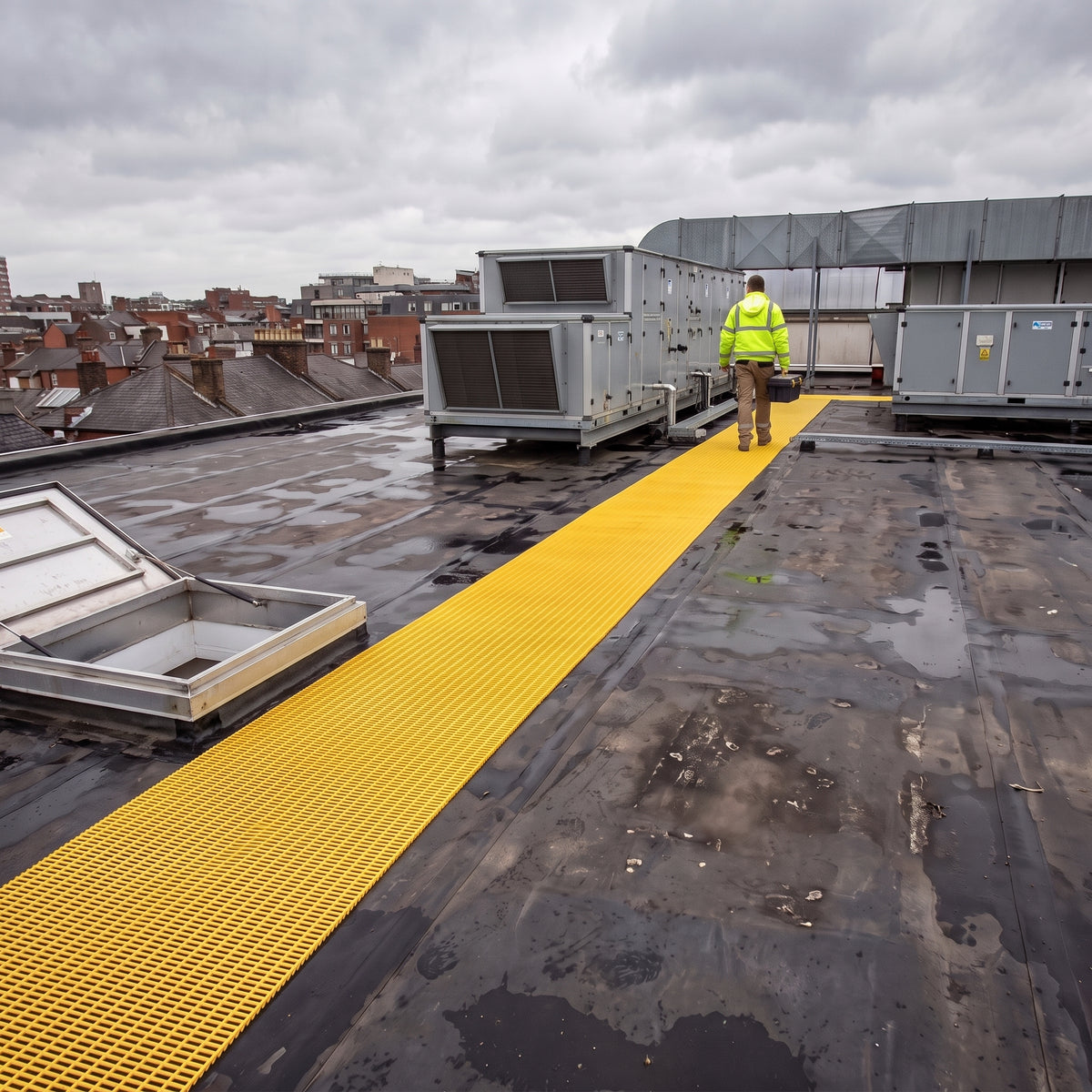
A walkway you can lay on a membrane roof without a single fixing — and lift again when the roof needs work.
Single-ply membrane roofs are easy to damage and expensive to repair. Every maintenance visit to the plant, the solar array or the gutters puts boots, dropped tools and trolley wheels onto a surface that was never meant to take them. This matting gives those visits a defined, slip-resistant route and keeps the membrane underneath untouched.
It is made from the same family of material as the roof — thermoplastic polyolefin (TPO) — so it sits on TPO and EPDM membranes without plasticiser migration or staining, and it is welded into a single two-layer piece that contours to the roof falls. At 12mm high it lifts the walker clear of standing water; the embossed top bars give a firm grip and the open lattice lets rain drain straight through. Loose laid, no adhesive, no mechanical fixings: roll it out and walk on it. Choose grey, white or yellow and a 0.6m or 0.75m wide 10m roll above.
LOOSE LAY, NO FIXINGS
Nothing penetrates the membrane. The roll is laid straight onto the roof, cut to length on site, and can be lifted or rolled back for cleaning, inspection or re-roofing.
STAYS PUT IN WIND
Loose laid, it stays in position in winds up to 55mph (89 km/h). In flat-platform laboratory testing at the University of Hertfordshire it remained in place to 88mph (142 km/h).
MEMBRANE-SAFE MATERIAL
TPO on TPO. No PVC plasticisers to migrate into the roof covering, phthalate free, and the flexible welded construction spreads point loads from tools, ladders and trolley wheels.
WORKS IN ANY WEATHER
Rated for service from -23°C to +60°C, UV resistant for permanent exterior use, and V10 drainage so rain never sits on the walking surface.
WHICH ROOF IS IT FOR?
| TPO single-ply | This mat. Same polymer family as the membrane, so there is nothing to migrate or stain over years of contact. |
| EPDM rubber | This mat. EPDM is sensitive to plasticisers from PVC products left on it long term; TPO avoids the problem. |
| PVC single-ply | Either. The 14mm PVC walkway matting is the usual choice and is rated R11. |
| Felt, asphalt, mastic, concrete, metal deck | Take the 14mm PVC walkway matting. Heavier, higher slip rating, wider choice of widths. |
| Green or ballasted roofs | Ask. The route usually needs a paved or decked strip rather than loose-laid matting. |
HOW MUCH DO I NEED?
| 10m x 0.6m roll | Covers 6.0 m². Weighs about 31 kg. The standard single-file access route — hatch to plant, plant to plant, along a gutter run, between solar panel rows. |
| 10m x 0.75m roll | Covers 7.5 m². Weighs about 39 kg. For routes where two people pass, plant replacement corridors, or where equipment is wheeled along the walkway. |
| Planning the route | Measure from the access point to every item of plant that gets a visit. Add a working area at each unit — typically 1m deep by the width of the unit. Round up to whole rolls, and keep an offcut for under ladder feet and step platforms. |
| Worked example | Hatch to two air-handling units, 14m of route plus a 1m x 2m working area at each unit: 14m of 0.6m roll plus 4 m² of working area = three 0.6m rolls with 4m spare for the ladder and the outlet. |
| Cut lengths | Not listed here. Send us the lengths and we will price them cut to size. |
COLOURS
Three stock colours, all the same mat and the same price.
- Grey — the default. Sits quietly against grey and white membranes and hides dust and rooftop soiling.
- White — for white reflective (cool roof) membranes where the walkway should not read as a dark stripe from above, and where solar gain matters.
- Yellow — high-visibility route marking. Makes the safe path obvious to contractors who do not know the roof.
Other colours are produced to order for larger projects — ask with the quantity and we will confirm lead time.
JOINING & ANCILLARIES
| End to end | Rolls butt together on the roof. On most routes that is all that is needed — the weight of the mat holds the joint. |
| Connector clips | Dual-purpose clips (14mm, packs of 10) join sections side to side or end to end where a run must stay as one piece — exposed corners, routes that contractors drag equipment along. Available with the order; see matting accessories or ask. |
| Edging | Not normally needed on a roof. Where a walkway meets a paved terrace or a door threshold, ramped PVC edging is available in the matching height. |
TYPICAL APPLICATIONS
- Access routes across TPO and EPDM single-ply roofs
- Walkways to rooftop plant, air-handling units, chillers and condensers
- Maintenance paths between solar panel rows
- Gutter, outlet and rooflight inspection routes
- Protection under ladders, step platforms and plant bases
- Temporary protection during re-roofing and plant replacement
- Roof-level plant compounds on schools, hospitals, offices and distribution sheds
TECHNICAL SPECIFICATION
| Composition | Thermoplastic polyolefin (TPO), two-layer welded construction with embossed top bars over an open lattice. Phthalate free |
| Height | 12mm (1/2") |
| Roll sizes | 10m x 0.6m (6.0 m²) | 10m x 0.75m (7.5 m²) |
| Tolerances | Height ±0.5mm | length 0 / +0.3m | width ±1cm. All dimensions nominal |
| Weight | 5.2 kg/m² (1.1 lb/sq.ft) — about 31 kg or 39 kg per roll |
| Colours | Grey, white or yellow from stock; other colours to order |
| Slip resistance (DIN 51130) | R9 |
| Slip resistance (ASTM E303) | Dry 74 with the lines / 94 across the lines; wet 58 / 80 (manufacturer web data; the printed data sheet quotes dry 67 / 97, wet 54 / 77) |
| Drainage (DIN 51130) | V10 |
| Wind resistance | Stable when loose laid to 55mph (89 km/h); 88mph (142 km/h) on a flat platform under laboratory conditions |
| Fire | EN ISO 13501-1:2007 — Dfl-s1 |
| Service temperature | -23°C to +60°C (-9°F to +140°F). Slight size variation may occur at temperature extremes |
| Fixing | Loose laid. No adhesive, no mechanical fixings, no penetrations |
| Acoustic | Excellent sound absorption properties |
| UV light | UV resistant, for permanent external use |
| Environment | 100% recyclable; contains no SVHC substances under REACH; phthalate free |
| BIM | Revit and IFC objects available on request |
FOR SPECIFIERS
Suggested clause: Loose-laid roof walkway matting, thermoplastic polyolefin, two-layer welded construction, 12mm high, 5.2 kg/m², slip resistance DIN 51130 R9, drainage DIN 51130 V10, reaction to fire EN ISO 13501-1 Dfl-s1, stable when loose laid to 55mph, phthalate free, REACH SVHC free, laid without adhesive or mechanical fixing on TPO / EPDM membrane. 10m rolls, [0.6m / 0.75m] wide, colour [grey / white / yellow].
Tell us the roof type, the route length and the number of plant items and we will return a marked-up quantity, the data sheet and BIM objects for the model.
INSTALLATION
Sweep the route clear of grit, loose fixings and debris. Unroll the matting along the route and let it relax flat — it contours to the roof falls and over upstands. Cut to length on site with a sharp knife; cut around outlets, upstands and plant bases as needed. Butt rolls end to end for longer runs and fit connector clips where a section must stay joined. No adhesive, no fixings, no site survey. Nothing is fixed through the membrane, so it can be lifted for roof inspections or moved when the plant layout changes.
CLEANING & MAINTENANCE
Routine: lift or roll back the matting and brush or hose the debris off the membrane beneath. The mat itself is non-porous and cleans with a stiff brush or a high-pressure hose.
Annual: walk the route with the roof inspection, re-lay any section moved by contractors, and check that outlets under the mat are clear.
After works: lift the mat where trades have been working, sweep out screws and swarf, and re-lay. The point of the mat is what it keeps off the membrane; that only leaves the roof when someone lifts it.
DOWNLOADS
- Technical data sheet (PDF, 2 pages) — sizes, tolerances, performance data, route planning, installation and cleaning.
- BIM objects (Revit / IFC) — available on request; tell us the project and we will send them over.
FREQUENTLY ASKED QUESTIONS
Will it damage the membrane?
No. It is made from TPO, laid loose with no fixings, and its job is to take the foot traffic and dropped tools that would otherwise reach the roof covering.
Why not just use PVC walkway matting on a TPO or EPDM roof?
PVC matting contains plasticisers that can migrate into TPO and EPDM membranes over years of contact and mark or embrittle them. A TPO mat has none, so it can stay down for the life of the roof.
Does it need fixing down?
No. Loose laid it stays in position in winds up to 55mph. On very exposed roofs, or where a corner can catch the wind, tell us the site and we will advise on layout and clips.
Can it be used on PVC, felt or asphalt roofs?
It will work, but the 14mm open-lattice PVC walkway matting is the better choice there. This TPO version exists so that TPO and EPDM membranes are not in long-term contact with PVC.
Is it safe when wet, icy or snowy?
Rain drains straight through the open lattice and the embossed top bars give a firm footing; it is rated R9 for slip resistance and V10 for drainage, and it is designed to function down to -23°C. Snow and ice should be cleared from any roof walkway before use.
Can I cut it to fit?
Yes, on site with a sharp knife. Cut around outlets, upstands and plant bases as required, or ask us to cut lengths before dispatch.
Do you have BIM objects and a data sheet?
Yes. The data sheet is in the Downloads section above; Revit and IFC objects are sent on request.
Do you sell other sizes or colours?
The two roll widths and three colours above are stocked. Other colours are made to order for larger projects, and we can supply cut lengths.
Product details
| SKU | IPM-CTP-GRY-060-10M |
|---|---|
| Material | Tpo |
| Form | Mat |
More from this range
Request a quote
Fast, no-obligation price from our UK team for:Roof Walkway Matting for TPO & EPDM – 12mm Loose-Lay Slip-Resistant