
Rubber & FoamSKU IP-PES-19X3-10M
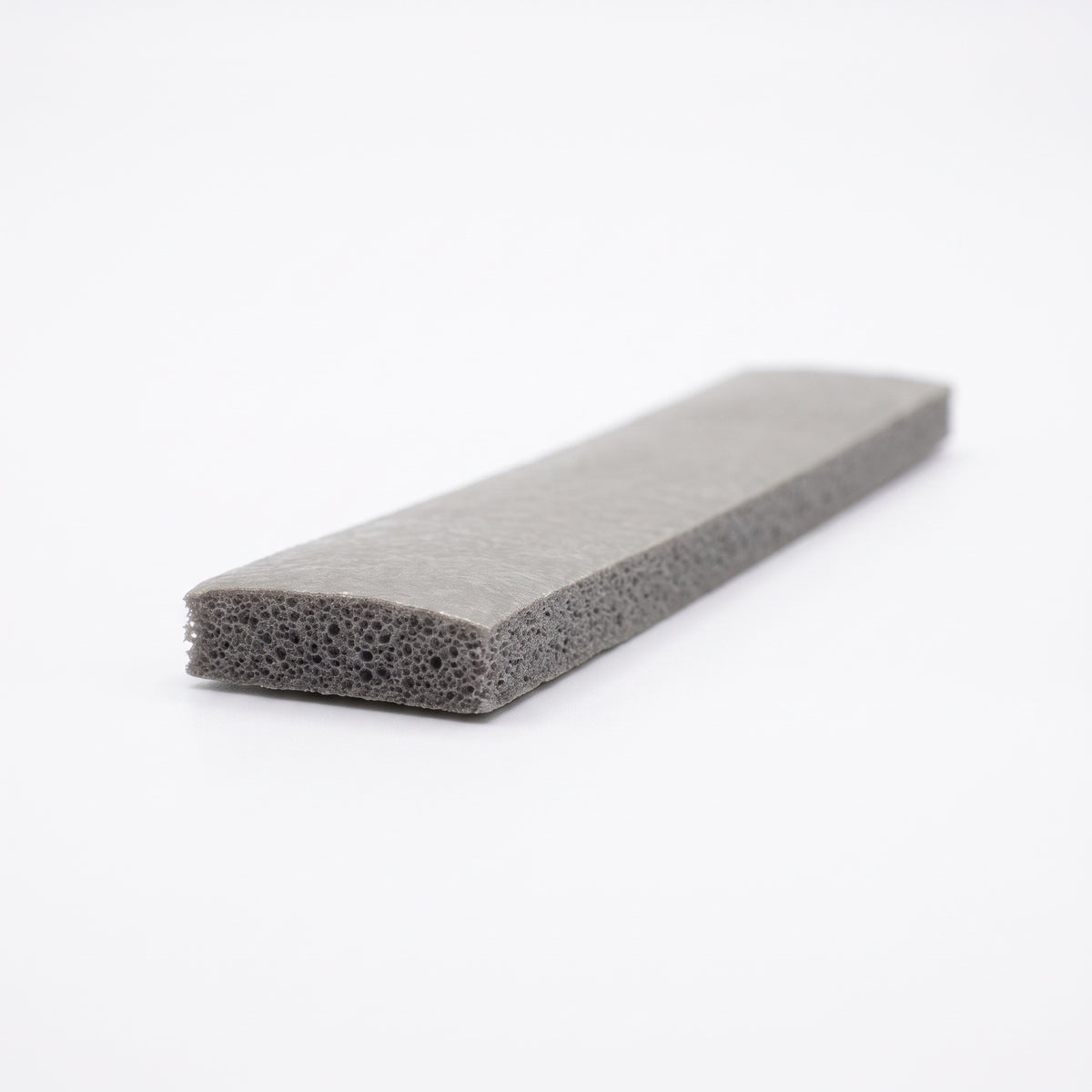
Polyethylene Sponge Strip – 19mm x 3mm, Self-Adhesive – Closed-Cell PE Foam, Grey – 10m Roll
A thin, self-adhesive polyethylene sponge strip, 19mm wide x 3mm thick, for sealing gaps of about 2.4mm to 2.55mm on enclosure doors, access panels, equipment cases, cabinets, windows and vehicle, marine and caravan trim. The wide 19mm face gives a broad, forgiving contact band on flanges that are not perfectly aligned. The foam is closed-cell and cross-linked, so it does not soak up water, and it seals with only a 15–20% squeeze. The adhesive is factory-applied to the 19mm face: peel the liner and press it on. Grey, supplied as one continuous 10m strip from UK stock.
At a glance
- Size: 19mm wide x 3mm thick, flat rectangular section; adhesive on the 19mm face
- Seals a closed gap of roughly 2.4–2.55mm (15–20% compression of the 3mm thickness)
- Closed-cell, cross-linked PE foam with a fine, even cell structure that spreads pressure and recovers after repeated closing
- Very wide temperature range: −60°C to +100°C in use
- Light and soft: 10g per metre; 33 kg/m³ block density; cuts with scissors or a sharp knife
- Value: £23.67 per 10m strip inc VAT, which is about £2.37 per metre
Typical uses
- Dust and splash seals on electrical, control and instrument enclosure doors and covers
- Gaskets for access panels, inspection plates, cabinets and equipment cases
- Low-profile door and window seals in vehicles, boats, caravans, sheds and transport
- Vibration-isolation and anti-rattle pads between panels, trims, glass and brackets
- Shock-absorbing cushion strips, case inserts and packaging liners
Technical drawing

Nominal dimensions in mm, free state before compression, drawn at true proportion (about 6.3 : 1). The 3mm thickness is the foam only; the adhesive and liner sit under the 19mm face.
How it seals

Stick the strip flat on the frame or flange with the 19mm face down. When the cover or door closes, the foam is squeezed by 15–20% (from 3mm to about 2.4–2.55mm), which is enough for a dust, air and splash seal. If the gap varies along its length or is 3mm or more, choose a thicker strip.
Which size do I need?
Measure the gap between the frame and the closed cover or door (feeler gauges or a stack of card). Pick a strip about 20–25% thicker than the gap. If the gap varies, go thicker. Choose the width to suit your flange.
| Strip | Width x thickness | Seals a gap of about |
|---|---|---|
| PE sponge strip 12.5 x 2mm | 12.5 x 2mm | 1.6–1.7mm |
| PE sponge strip 10 x 3mm (narrower face) | 10 x 3mm | 2.4–2.55mm |
| PE sponge strip 19 x 3mm (this item) | 19 x 3mm | 2.4–2.55mm |
| PE sponge strip 10 x 4mm | 10 x 4mm | 3.2–3.4mm |
| PE sponge strip 25 x 6mm | 25 x 6mm | 4.8–5.1mm |
| PE sponge strip 19 x 12mm (same width, thicker) | 19 x 12mm | 9.6–10.2mm |
Gap figures are worked out from each strip's thickness and the 15–20% sealing compression.
Specification
| Property | Value | Test method / source |
|---|---|---|
| Profile and dimensions | ||
| Profile | Flat rectangular foam strip, self-adhesive one face | – |
| Width (adhesive face) | 19 mm | Nominal, manufacturer data |
| Thickness (foam only) | 3 mm | Nominal, manufacturer data |
| Adhesive position | On the 19 mm (widest) face, with peel-off liner | Manufacturer data |
| Length | 10 m continuous strip | – |
| Weight | 0.01 kg/m (about 0.1 kg per 10 m strip) | Manufacturer data |
| Recommended closed gap | ≈ 2.4–2.55 mm | Derived from 3 mm and 15–20% compression |
| Dimensional tolerance | Not stated by the manufacturer for this profile | – |
| Material | ||
| Material | Cellular polyethylene (PE) | Manufacturer data |
| Cell structure | Closed cell, cross-linked, fine and uniform | Manufacturer data |
| Colour | Grey | – |
| Density (block) | 33 kg/m³ | Manufacturer data, method not stated |
| Density (range) | 28–38 kg/m³ | Manufacturer data, method not stated |
| Hardness | Not stated for this foam (soft, low-density) | – |
| Mechanical properties | ||
| Tensile strength | > 250 kPa (> 0.25 MPa) | Manufacturer data, method not stated |
| Elongation at break | > 170 % | Manufacturer data, method not stated |
| Compressive strength at 10% deflection | 35–55 kPa | Manufacturer data, method not stated |
| Compressive strength at 25% deflection | 55–85 kPa | Manufacturer data, method not stated |
| Compressive strength at 50% deflection | 120–170 kPa | Manufacturer data, method not stated |
| Compression set, 22 h at 23 °C | 15 % | Manufacturer data, method not stated |
| Tear strength | Not stated for this product | – |
| Compression needed to seal | 15–20 % | Manufacturer data |
| Environment | ||
| Working temperature | −60 °C to +100 °C | Manufacturer data |
| Water absorption | No figure given for this size; closed-cell structure resists water uptake | Manufacturer data (descriptive) |
Materials and compliance
The strip is closed-cell, cross-linked polyethylene foam with a pressure-sensitive adhesive backing. The manufacturer does not state any product approvals (for example food contact, fire rating, REACH or RoHS) for this strip, so we do not claim any. If you need a declaration for your application, ask us before ordering and we will check what is available.
Fitting tips
- Clean the surface with isopropyl alcohol or a degreaser and let it dry. Fit above about +10°C if you can, since the adhesive grabs better when warm.
- Peel back a short length of liner at a time and press the strip down as you go. Do not stretch it, or it will creep back and open gaps at the ends.
- Run a thumb or roller along the full length to bed the adhesive in. The bond gets stronger over the first day.
- At corners, bend the strip round a gentle radius or cut and butt the ends tightly together; for a sharp corner, cut a 45° mitre.
Frequently asked questions
What gap does this strip seal?
About 2.4mm to 2.55mm when closed. It only needs a 15–20% squeeze to seal. A gap of 3mm or more will not seal; choose the 10 x 4mm, 25 x 6mm or 19 x 12mm strip instead.
Which face is the adhesive on?
The 19mm (wide) face, so the strip lies flat and stands just 3mm proud of the surface.
Why choose 19 x 3mm rather than 10 x 3mm?
Both seal the same gap. The 19mm face gives a wider contact band, more adhesive area and more tolerance if the door or cover does not land exactly in line. Use 10 x 3mm on narrow flanges.
Can I use it where it gets wet or cold?
Yes. The closed cells resist water uptake and the foam works from −60°C to +100°C. For long-term outdoor exposure to strong sun, check it at intervals, as with any PE foam.
How do I cut and join it?
Scissors or a sharp knife cut it cleanly. Join lengths by butting the ends tightly together; on a seal, put the joint where the cover presses hardest, not at a corner.
Will it stick to painted metal, plastic, glass or wood?
Yes, to most clean, dry, rigid surfaces, smooth or slightly rough. Very low-energy plastics (some PP and PE mouldings) and dusty or oily surfaces stick less well. Clean and test a short piece first.
Is it good for vibration and rattles?
Yes. It is soft (35–55 kPa at 10% squeeze) and recovers well (15% compression set), so it makes a thin anti-rattle, anti-scratch and vibration-isolating layer between panels, trims and brackets.
How much do I get?
One continuous 10m strip, about 0.1kg. A 600 x 800mm enclosure door has a 2.8m perimeter, so one strip seals three doors.
Is it in stock?
Yes. It is held in stock in the UK and ships from our warehouse.
Need help choosing a size or a material? Contact our team on +44 1282 277786 or sales@industrial-polymers.co.uk.
Product details
| SKU | IP-PES-19X3-10M |
|---|---|
| Weight | 0.22 lb |
More from this range
Request a quote
Fast, no-obligation price from our UK team for:Polyethylene Sponge Strip – 19mm x 3mm, Self-Adhesive – Closed-Cell PE Foam, Grey – 10m Roll